
Table of Contents
EV Charging for Fleet Operators | Enterprise Depot & Fleet Electrification
The commercial transportation sector is undergoing its most profound structural realignment since the transition from horse-drawn carriages to the internal combustion engine. Driven by strict zero-emission vehicle (ZEV) mandates, rapidly declining lithium-ion battery pack costs, corporate ESG commitments, and favorable Total Cost of Ownership (TCO) economics, commercial logistics platforms, transit agencies, last-mile delivery providers, and corporate transport operations are rapidly electrifying their vehicle fleets.
However, scaling an electric fleet involves far more than simply replacing diesel trucks or gasoline delivery vans with battery-electric alternatives. The true operational bottleneck lies in the design, engineering, software orchestration, and grid integration of EV charging for fleet operators.
Unlike public commercial charging networks—which focus on consumer retail payments and ad-hoc vehicle access—fleet charging depots operate under strict operational constraints. Every minute a commercial vehicle sits idle without adequate battery charge translates directly into lost revenue, delayed delivery SLAs, and supply chain friction.
This comprehensive guide delivers an end-to-end operational blueprint for fleet vice presidents, logistics directors, dispatch managers, and enterprise facility engineers to design, deploy, scale, and optimize commercial fleet charging infrastructure.
1. The Financial Case: Achieving TCO Parity and Energy Margin Control
For commercial fleet operators, vehicle acquisition cost (CapEx) is only one variable in the financial equation. The primary driver for fleet electrification is the dramatic reduction in operational expenditure (OpEx) over the vehicle’s operational lifecycle.
                      [Commercial Fleet TCO Advantage]
                                      │
       ┌──────────────────────────────┴──────────────────────────────┐
       ▼                                                             ▼
[Energy Cost Optimization]                                  [Maintenance Reduction]
 • 60-70% Lower Cost per Mile vs. Diesel                    • 40-50% Reduction in Mechanical Wear
 • Off-Peak Utility Tariff Scheduling                       • Elimination of Exhaust / DPF Systems
 • Fixed Fuel Costs via Long-Term Contracts                 • Regenerative Braking Pad Preservation
1. Fuel Cost Suppression and Energy Volatility Hedging
Diesel and gasoline prices fluctuate unpredictably based on geopolitical factors and global oil markets. Electricity, when managed through automated smart charge scheduling, offers predictable, lower operational costs.
On a cost-per-mile basis, charging a light- to medium-duty electric delivery van costs 60% to 70% less than fueling a comparable internal combustion engine (ICE) vehicle. By scheduling depot charging during off-peak overnight utility windows, fleet operators lock in low energy tariffs.
2. Radical Reduction in Mechanical Maintenance
Internal combustion commercial vehicles feature thousands of moving parts prone to wear and tear—including complex multi-speed transmissions, diesel particulate filters (DPF), turbochargers, fuel injectors, and intricate exhaust scrubbers.
Electric commercial drive trains eliminate these failure points. Regenerative braking systems absorb the majority of deceleration energy, reducing brake pad wear by up to 50%. Overall, fleet operators experience a 40% to 50% drop in lifetime vehicle maintenance costs.
2. Fleet Archetypes and Charging Infrastructure Taxonomy
Designing a fleet charging depot requires matching vehicle battery capacities, daily route mileages, and yard dwell times with appropriate charging hardware.
┌────────────────────────────────────────────────────────────────────────────────────────┐
│                        COMMERCIAL FLEET CHARGING HARDWARE MATRIX                       │
├───────────────────────────────┬───────────────────────────────┬────────────────────────┤
│ Commercial Fleet Archetype    │ Recommended Hardware Standard │ Target Yard Dwell Time │
├───────────────────────────────┼───────────────────────────────┼────────────────────────┤
│ Last-Mile Delivery Vans       │ Level 2 AC (11 kW - 19.2 kW)  │ 6 to 10 Hours          │
│ Regional Delivery Trucks      │ High-Power DCFC (60kW-180kW)  │ 1 to 3 Hours           │
│ Heavy Class 8 Freight         │ Ultra-Fast / MCS (360kW-1.2MW)│ 30 to 60 Minutes       │
│ Municipal Transit / Buses     │ Overhead Pantograph DCFC      │ 10 to 30 Minutes       │
└───────────────────────────────┴───────────────────────────────┴────────────────────────┘
1. Return-to-Base Overnight Fleets (Light- to Medium-Duty)
- Fleet Examples: Last-mile delivery vans (e.g., Amazon, FedEx, DHL), municipal service vans, tradesperson vehicles, and passenger shuttle fleets.
- Operational Pattern: Vehicles operate fixed daily routes (50 to 120 miles) during daylight hours and return to a central depot yard in the evening, remaining parked for 8 to 12 hours overnight.
- Optimal Hardware: High-output Level 2 AC Commercial Chargers (11 kW to 19.2 kW). Level 2 hardware delivers low capital expenditure, simple installation, and low electrical distribution stress when governed by smart load-balancing software.
2. High-Turnover Regional Logistics Fleets (Medium- to Heavy-Duty)
- Fleet Examples: Regional beverage distributors, cross-dock logistics trucks, and double-shift delivery vehicles.
- Operational Pattern: Vehicles operate multiple delivery shifts per day with short 1 to 3-hour loading bay dwell times between runs.
- Optimal Hardware: High-Power DC Fast Chargers (60 kW to 180 kW). These units supply rapid energy top-ups during cargo loading and driver shift changes.
3. Long-Haul Heavy Freight and Class 8 Drayage
- Fleet Examples: Port drayage trucks, intermodal heavy haulers, and long-haul Class 8 tractor-trailers equipped with massive 300 kWh to 800+ kWh battery packs.
- Operational Pattern: Continuous high-speed transit requiring rapid energy replenishment during mandatory driver rest breaks.
- Optimal Hardware: Ultra-Fast DC Fast Chargers (360 kW+) or emerging Megawatt Charging Systems (MCS) capable of delivering up to 1.2 MW of direct current power through liquid-cooled cables and automated connectors.
3. The Digital Core: Automated Charging Management Systems (CMS) & Telematics
Hardware alone cannot run a commercial fleet depot. The operational nerve center of an electrified fleet is the Charging Management System (CMS), which acts as the digital orchestrator between vehicles, depot chargers, grid capacity, and enterprise resource planning (ERP) software.
                         [Fleet Software API Integration Sync]
                                          │
       ┌──────────────────────────────────┼──────────────────────────────────┐
       ▼                                  ▼                                  ▼
[Vehicle Telematics (Samsara/Geotab)]  [Fleet CMS Orchestrator]     [Utility Tariff & Grid API]
 • Real-time State of Charge (SoC)     • Automated Charge Priority   • Dynamic Utility Time-of-Use
 • Departure Time & Route Distance     • Power Draw Capping          • Demand Charge Prevention
 • Battery Health & Temperature        • ISO 15118 Plug & Charge     • V2G Dispatch Optimization
1. Automated Telematics Synchronization
Leading fleet CMS platforms connect directly via APIs with enterprise telematics systems (such as Geotab, Samsara, or Verizon Connect).
When a commercial vehicle enters the depot yard and plugs in, the CMS automatically reads real-time vehicle diagnostics:
- Current battery State of Charge (SoC)
- Scheduled departure time for the next morning shift
- Required kilowatt-hour ($kWh$) energy capacity based on assigned route distance
2. Automated Smart Charge Prioritization
Instead of charging every vehicle at full power simultaneously—which creates massive electrical demand spikes—the CMS prioritizes charging automatically:
- Priority 1: Vehicles assigned to long early-morning routes receive maximum charging power first.
- Priority 2: Vehicles with high baseline battery levels or afternoon departure times are assigned lower charge rates, charging slowly during late-night off-peak utility hours.
3. Plug & Charge (ISO 15118) and AutoCharge Automation
To eliminate driver friction and manual human error, fleet chargers utilize ISO 15118 Plug & Charge standards.
Drivers simply plug the charging connector into the vehicle socket. The charger automatically reads the vehicle’s encrypted cryptographic Vehicle Identification Number (VIN), authenticates the session instantly, and begins energy delivery without requiring RFID badge taps, key fobs, or smartphone app interaction.
4. Electrical Grid Engineering & High-Voltage Infrastructure
Deploying multi-megawatt fleet charging hubs requires heavy high-voltage civil engineering and utility coordination.
                       [Depot Electrical Infrastructure Hierarchy]
                                           │
                                           ▼
                     [ 11kV / 33kV Utility High-Tension (HT) Line ]
                                           │
                                           ▼
                    [ Dedicated Step-Down Transformer Sub-Station ]
                                           │
                                           ▼
                     [ Primary Switchgear & Air Circuit Breakers ]
                                           │
                                           ▼
            ┌──────────────────────────────┴──────────────────────────────┐
            ▼                                                             ▼
[Dynamic Load Management (DLM)]                              [Depot Utility Sub-Panel]
 (Caps Depot Power Draw)                                      (Powers Facility Lighting/Office)
1. High-Tension (HT) Sub-Stations and Transformer Sizing
A logistics depot operating 50 medium-duty electric trucks using 50 kW fast chargers requires a peak electrical capacity of 2.5 Megawatts (MW)—equivalent to the power consumption of a small town.
To support these operational loads, fleet operators must install dedicated High-Tension (HT) utility step-down sub-stations (11kV or 33kV), primary/secondary switchgear panels, vacuum circuit breakers (VCB), and protective earthing systems.
2. Dynamic Load Management (DLM) and Demand Charge Elimination
Utilities charge commercial customers heavy financial penalties—known as demand charges—if their peak power draw crosses contracted threshold limits for even a 15-minute window during a billing cycle.
Dynamic Load Management (DLM) software acts as an automated buffer:
- DLM tracks real-time depot building loads (office HVAC, conveyor systems, warehouse lighting).
- It dynamically caps the total power allocated to the charging bays, ensuring the combined depot draw never breaches utility contract limits.
3. Microgrids: Integrating Rooftop Solar PV and Battery Energy Storage (BESS)
To further insulate operations from grid limits and high utility rates, modern fleet depots deploy on-site microgrids:
- Rooftop Solar PV: Large warehouse roofs generate low-cost renewable energy during daytime hours.
- Battery Energy Storage Systems (BESS): Stationary industrial battery banks store solar generation or off-peak grid energy. During peak evening charging hours, the BESS discharges energy into the fleet chargers, smoothing out grid demand spikes (peak shaving).
5. Implementation Framework: Step-by-Step Fleet Electrification
Deploying an electric fleet depot requires an organized, multi-phase execution timeline:
1.Execute Fleet Feasibility & Energy Profiling:Phase 1: Route Audit & Duty Cycle Analysis.
Analyze historical telematics data across all fleet routes. Map vehicle daily mileage, cargo payload weights, return-to-base times, and required yard dwell windows. Calculate the precise kilowatt-hour (kWh) energy appetite per vehicle class.
2.Conduct Utility Interconnection Audit & Civil Design:Phase 2: Grid Capacity & Site Engineering.
Engage local electric utilities to conduct a grid capacity assessment at the depot location. Design single-line electrical diagrams (SLD) detailing High-Tension (HT) step-down transformers, switchgear ratings, cable trenching layouts, and BESS microgrid integration points.
3.Procure OCPP Hardware & Fleet CMS Platform:Phase 3: Hardware Procurement & Software Sync.
Select smart, OCPP-compliant commercial chargers equipped with overhead cable retractors and NEMA 4X/IP66 weatherproofing. Procure a fleet Charge Point Management System (CMS) that natively integrates via APIs with Samsara, Geotab, or legacy fleet telematics.
4.Execute Transformer Installation, Trenching & Mounting:Phase 4: Heavy Civil Works & Electrical Setup.
Pour reinforced concrete pads for transformers and power cabinets. Execute heavy trenching, conduit laying, and armored cabling run to parking bays. Mount heavy-duty protective steel bollards and overhead cable suspension arms.
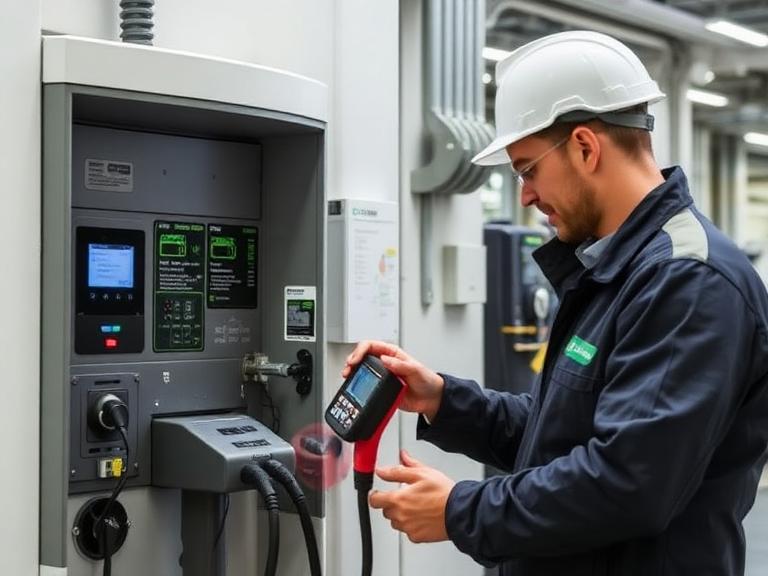
5.Verify AutoCharge, DLM & Driver Onboarding:Phase 5: Commissioning & Automated Testing.
Execute high-voltage insulation checks, earth resistance testing, and emergency stop verifications. Test Plug & Charge (ISO 15118) automatic vehicle identification. Train dispatch personnel and fleet drivers on depot procedures.
6. Comparative Breakdown: Fleet Electrification Deployment Models
Evaluating operational requirements across different fleet scales ensures optimal capital allocation and system design:
| Commercial Fleet Scale | Primary Vehicle Classes | Recommended Charging Hardware | Core Energy Infrastructure | Estimated Turnkey Infrastructure Budget |
| Last-Mile Delivery Depot (20–50 Vans) | Light-Duty Electric Vans (Class 2–3) | 20–50 Dual-Port Level 2 AC (11kW–19.2kW) | 500kVA Standard Transformer + Cloud CMS | $120,000 — $320,000 |
| Regional Logistics Hub (30–80 Delivery Trucks) | Medium-Duty Box Trucks (Class 4–6) | 15–30 High-Power DCFC (60kW–180kW) | 2.5MVA HT Transformer Sub-Station + DLM Software | $450,000 — $1,200,000 |
| Heavy Intermodal Freight Terminal (15–40 Semis) | Heavy-Duty Class 8 Tractors & Drayage | 10–20 Ultra-Fast DCFC / MCS (360kW–1.2MW) | 5MVA+ Dedicated HT Sub-Station + 1MW BESS Microgrid | $1,800,000 — $4,500,000+ |
7. Incentives, Policy Grants, and Financial Subsidies
Governments globally offer direct financial subsidies to accelerate commercial fleet electrification:
- United States: The federal Section 30C Alternative Fuel Infrastructure Tax Credit provides tax credits covering up to 30% of commercial charging installation expenses (up to $100,000 per location). The EPA Clean Heavy-Duty Vehicles Grant Program delivers hundreds of millions in direct grants covering zero-emission Class 6 and Class 7 vocational trucks and supporting depot infrastructure.
- India: Central programs including PM E-DRIVE (backed by multi-thousand crore budget allocations) alongside progressive state EV policies (e.g., Maharashtra, Delhi, Gujarat, Karnataka, Tamil Nadu) provide 25% to 100% capital cost subsidies on upstream transformer infrastructure and commercial fast chargers, paired with dedicated industrial EV power tariffs.
- Europe & UK: The EU’s Alternative Fuels Infrastructure Regulation (AFIR) mandates high-capacity heavy-duty vehicle charging pools along core transport corridors, supported by regional capital grants and accelerated asset depreciation models.

8. Frequently Asked Questions (15 Detailed FAQs)
FAQ 1: Why is dedicated EV charging infrastructure necessary for commercial fleet operators?
Commercial fleets operate on strict delivery schedules, fixed routes, and tight operational windows. Relying on public charging infrastructure exposes fleet operators to unpredictable charger availability, long queue times, high retail electricity tariffs, and severe operational downtime. Dedicated depot charging gives fleet operators 100% control over vehicle turnaround times, energy cost optimization, and automated telematics integration.
FAQ 2: What type of EV chargers should a commercial fleet operator install?
Fleet charging strategy depends on vehicle dwell time and battery pack size. High-output Level 2 AC chargers (11 kW to 19.2 kW) are optimal for light-duty commercial vans or passenger fleets that return to base for overnight charging (6–10 hours). High-power DC Fast Chargers (60 kW to 360 kW+) or Megawatt Charging Systems (MCS) are mandatory for medium- and heavy-duty trucks, regional haulers, and double-shift delivery fleets requiring rapid 20-to-60-minute top-ups.
FAQ 3: How does Charge Point Management System (CMS) software integrate with fleet telematics?
Modern fleet CMS platforms connect directly via APIs with enterprise telematics providers (such as Geotab, Samsara, or Verizon Connect). The software monitors vehicle State of Charge (SoC), scheduled departure times, route lengths, and energy consumption. It automatically schedules charging during off-peak utility hours while prioritizing power distribution to vehicles assigned to early morning routes.
FAQ 4: How do fleet operators avoid massive utility demand charges when charging multiple electric trucks?
Fleet operators deploy Dynamic Load Management (DLM) and automated peak-shaving software. DLM dynamically distributes available electrical capacity across active chargers, capping overall depot power draw to stay within contracted utility thresholds. Integrating on-site Battery Energy Storage Systems (BESS) and solar PV arrays further buffers the depot grid against demand charge spikes.
FAQ 5: What is the difference between Return-to-Base (Depot) charging and En-Route charging for fleets?
Return-to-Base (Depot) charging occurs at centralized, private fleet facilities where vehicles park overnight or during shift changes, utilizing controlled Level 2 or moderate DC fast charging. En-Route charging takes place at public or dedicated commercial charging hubs along transport corridors, utilizing high-powered DC Fast Chargers (150 kW to 350 kW+) or Megawatt systems to extend vehicle range mid-shift.
FAQ 6: How much does a commercial fleet charging depot installation cost?
Turnkey costs depend heavily on power requirements. A light-duty depot node deploying dual-port Level 2 AC chargers costs between $6,000 and $15,000 per node including civil works. Heavy-duty fleet depots deploying 100 kW to 360 kW DC Fast Chargers range from $60,000 to over $220,000 per unit, heavily influenced by High-Tension (HT) sub-station and utility grid interconnect upgrades.
FAQ 7: What High-Tension (HT) electrical infrastructure is required for large-scale fleet depots?
Large-scale fleet hubs charging dozens of medium- and heavy-duty trucks require dedicated High-Tension (HT) utility interconnections (11kV / 33kV), dedicated step-down transformers, primary/secondary switchgear, protective relays, and dedicated industrial metering panels capable of supporting multi-megawatt continuous loads.
FAQ 8: What automated authentication standards are used for fleet charging?
Fleet systems utilize Plug & Charge (ISO 15118) and AutoCharge protocols. When a driver plugs the charging cable into an electric truck or van, the charger automatically authenticates the vehicle’s encrypted cryptographic VIN, initiates the charging session, and logs energy telemetry to the fleet management system without manual RFID tapping or app activation.
FAQ 9: Are there government incentives, grants, or tax credits available for fleet electrification?
Yes. In the United States, programs like the Inflation Reduction Act (IRA) Section 30C tax credit cover up to 30% of commercial charging installation costs, alongside federal programs like the EPA Clean Heavy-Duty Vehicles Grant Program. In India, central policies like PM E-DRIVE and state industrial schemes offer up to 25%-100% capital subsidies on upstream electrical infrastructure.
FAQ 10: What is Vehicle-to-Grid (V2G) and how can fleet operators monetize parked electric vehicles?
Vehicle-to-Grid (V2G) technology allows parked electric commercial fleets (such as school buses or local delivery vans sitting idle) to discharge stored battery energy back into the power grid or depot building during peak demand hours. Utility grid operators pay fleet operators capacity payments or wholesale energy credits, generating revenue while offsetting depot charging costs.
FAQ 11: How long does it take to design and deploy a full-scale fleet charging depot?
Full-scale fleet depot projects typically take between 12 to 24 weeks. The timeline is largely determined by utility grid interconnection capacity audits, transformer lead times, civil trenching, hardware mounting, and telematics software commissioning.
FAQ 12: How does fleet electrification improve corporate ESG performance and ISO 14001 compliance?
Replacing internal combustion engine (ICE) fleets with zero-emission electric vehicles directly eliminates Scope 1 corporate emissions (direct tailpipe exhaust). Automated energy tracking via fleet CMS software provides auditable carbon offset data for corporate ESG disclosures and ISO 14001 environmental management systems.
FAQ 13: What durability and safety standards must commercial fleet chargers meet?
Commercial fleet chargers must feature NEMA 4X or IP65/IP66 weatherproof rated enclosures, IK10 impact resistance, liquid-cooled high-amperage cables, steel bollard collision barriers, and overhead counterbalanced cable retractor systems to eliminate trip hazards and prevent cable damage in busy depot yards.
FAQ 14: How do fleet operators handle en-route or take-home charging for employee vehicles?
For take-home commercial vehicle fleets (such as field service vans), fleet software provides home charging reimbursement modules. The CMS tracks energy dispensed by the employee’s home smart charger for company vehicle sessions and automatically generates monthly expense reimbursements on the employee’s utility bill.
FAQ 15: What ongoing maintenance is required for high-volume commercial fleet chargers?
Commercial fleet stations require preventative maintenance protocols: monthly physical cable/connector inspections, quarterly liquid-cooling loop fluid level checks for DC ultra-fast chargers, bi-annual thermal imaging audits of switchgear panels, and remote over-the-air (OTA) firmware updates.
9. Key Technical & Operational Launch Checklist
Verify these crucial technical parameters prior to opening your electrified fleet depot:
- [ ] Utility HT Sub-Station Sign-Off: Verified step-down transformer kVA capacity, primary switchgear interrupt ratings, and utility meter interconnections.
- [ ] Telematics API Sync: Confirmed real-time automated data exchange between Samsara/Geotab vehicle SoC streams and the fleet CMS orchestrator.
- [ ] AutoCharge / ISO 15118 Verification: Tested cryptographic VIN authentication across all fleet vehicle models.
- [ ] Dynamic Load Capping: Tested simulated grid failure scenarios to verify that the DLM software caps total depot kVA draw below contracted utility limits.
- [ ] Overhead Cable Retractors: Verified overhead cable arms keep high-amperage charging cables elevated off yard driving lanes.
- [ ] Emergency Power Shut-Off: Conducted physical testing of manual emergency power cut-off switches across all fleet charging bays.
Conclusion
Transitioning commercial fleets to electric mobility is a strategic operational imperative. By deploying purpose-built EV charging for fleet operators—combining high-voltage High-Tension grid engineering, telematics-driven software orchestration, and smart load management—fleet operators lock in long-term total cost of ownership advantages, eliminate operational downtime, and establish a resilient, zero-emission supply chain.
